
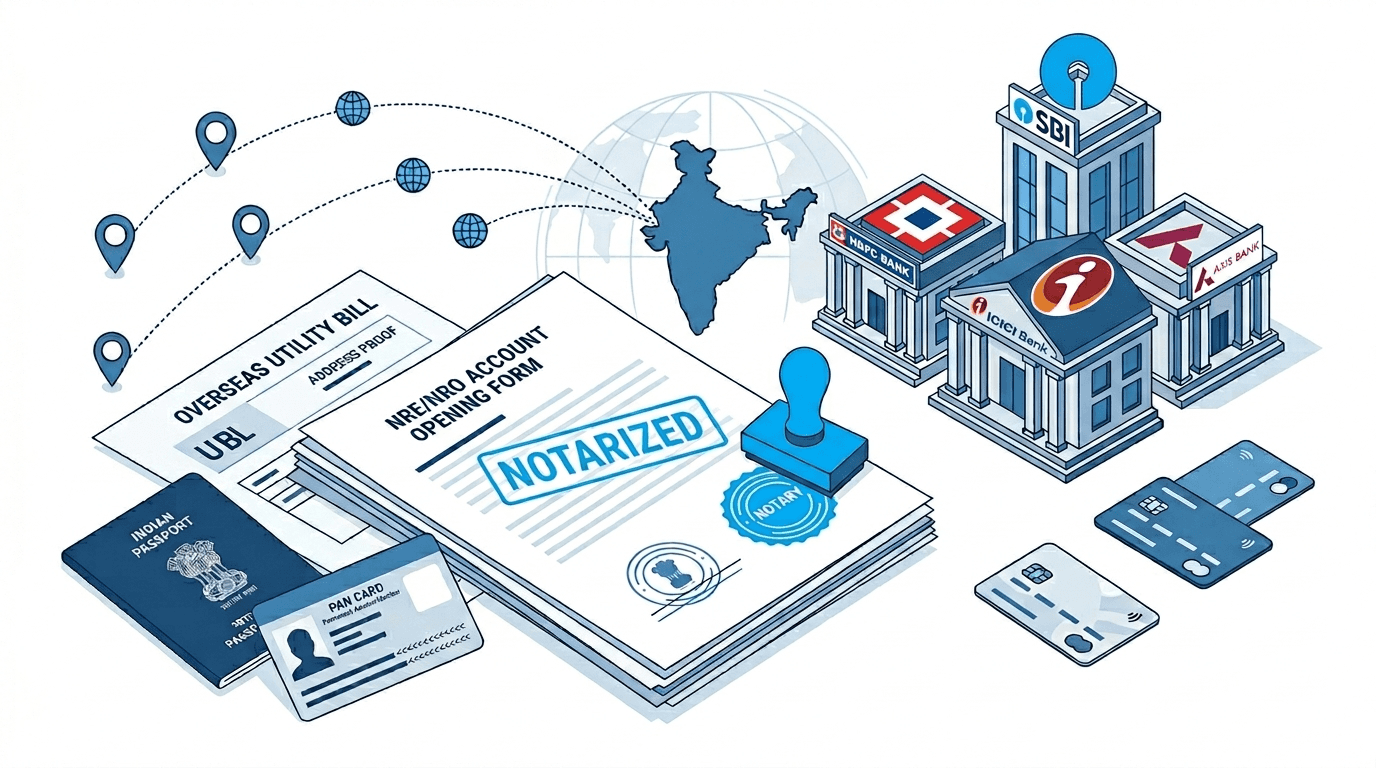
Accounts
4 Mins

Apoorva K
Team Rupeeflo
Opening an NRE or NRO account from abroad should be straightforward.
In practice, it’s often not - because document verification requirements vary by bank, and the terminology is inconsistently used. One bank says “attested.” Another says “certified.” A third accepts self-attestation for conversions but requires notarization for new account opening.
Getting this wrong means rejected applications, re-couriering documents, and weeks of unnecessary delays. This guide breaks down exactly what SBI, HDFC, ICICI, IDFC FIRST, Kotak, Axis, and DBS require - so you can get it right the first time.
Banks use words like notarized, attested, and certified almost interchangeably - but they’re not the same thing. Before you start, it helps to know the difference: Notarisation vs Apostille vs Affidavit: What India Actually Accepts →
Need your documents notarized? If your bank requires notarized copies,
Rupeeflo Digital Notarizationlets you complete the process online - no visit to a local notary needed.
At a Glance: What Each Bank Requires
Bank | New Account | Resident → NRO | Notarization |
|---|---|---|---|
SBI | ✅ | ✅ | Required |
HDFC | ✅ | ✅ | Required for new customers; self-attestation accepted for conversion |
ICICI | ✅ | ✅ | Required (digital conversion available for eligible customers) |
Axis | ✅ | ✅ | Required (apostille also accepted; Justice of Peace for AU/NZ) |
IDFC FIRST | ✅ | ✅ | Required (in-person meeting may exempt; confirm for conversion) |
Kotak Mahindra | ✅ | ✅ | Required |
DBS Bank | ✅ | ✅ | Required for opening; Embassy attestation for conversion |
Documents Required Across Most Banks
The core document set is consistent across banks: passport, visa/OCI/PIO card, overseas address proof, PAN card (or Form 60 if unavailable), a passport-size photograph, and a FATCA/CRS declaration where applicable. Beyond these, each bank has specific forms - detailed below.
Form 60 is a self-declaration used in place of a PAN card for specified financial transactions, such as opening a bank account or making high-value deposits.
1. State Bank of India (SBI)
SBI requires attested documents for both account opening and resident-to-NRO conversion. All submissions must be made by courier or post - email is not accepted.
Purpose | Required Documents | Document Authentication |
Account Opening |
| Notarized documents are accepted. SBI also recognizes certification by the Indian Embassy/High Commission, SBI Foreign Office/Representative Office, and Court Magistrate/Judge. |
Resident → NRO Conversion |
| Same as above. |
2. HDFC Bank
HDFC requires self-attested OVD (official valid document) copies for NRI account opening, with additional third-party certification for new-to-bank customers. Resident-to-NRO conversions generally accept self-attested documents.
Purpose | Required Documents | Document Authentication |
Account Opening |
| Digital notarization is one of the accepted methods. |
Resident → NRO Conversion |
| Same as above, although do check once with your RM if self attestation would suffice. In that case you need not do notarization - digital or physical route. |
Good to know: HDFC does not accept close-relative declarations, overseas bank statements, or lease/rent agreements as address proof. Physical forms with wet signatures are required.
3. ICICI Bank
ICICI requires certified documents for non-face-to-face account opening. So, technically for all NRIs opening this from abroad will need notarization. For eligible existing customers, resident-to-NRO conversion can be done digitally via internet or mobile banking.
Purpose | Required Documents | Document Authentication |
Account Opening (non-face-to-face) |
| Digital notarization is one of the accepted methods. |
Resident → NRO Conversion |
| Digital notarization is one of the accepted methods. |
Good to know: If non-agricultural income in India exceeds ₹4 lakh, ICICI may require a PAN card or PAN acknowledgement number.
4. IDFC FIRST Bank
IDFC FIRST requires certified KYC documents for NRE/NRO account opening. Applicants who meet an IDFC FIRST representative in person may be exempt from third-party certification.
Purpose | Required Documents | Document Authentication |
Account Opening |
| Digital notarization is one of the accepted methods. |
Resident → NRO Conversion |
| Confirm directly with IDFC FIRST Bank — attestation requirements for conversion are not fully specified in official documentation. |
5. Kotak Mahindra Bank
Kotak requires attested KYC documents by an approved authority for both account opening and resident-to-NRO conversion.
Purpose | Required Documents | Document Authentication |
Account Opening |
| Digital notarization is one of the accepted methods. |
Resident → NRO Conversion |
| Digital notarization is one of the accepted methods. |
6. Axis Bank
Axis Bank requires third-party attestation for remote NRI account opening and resident-to-NRO conversion. It’s one of the few banks that explicitly accepts apostille certification - and Justice of Peace attestation for Australia/New Zealand residents.
Purpose | Required Documents | Document Authentication |
Account Opening (non-face-to-face) |
| Digital notarization is one of the accepted methods. |
Resident → NRO Conversion |
| Digital notarization is one of the accepted methods. |
Good to know: If your current signature differs from your passport or bank records, Axis may ask for additional proof - a government-issued ID, personalized cheque, or notarized affidavit.
7. DBS Bank
DBS requires certified documents for NRI account opening.
Purpose | Required Documents | Document Authentication |
Account Opening |
| Notarized documents are accepted for account opening. |
Resident → NRO Conversion |
| For resident-to-NRO conversion submitted from abroad, Indian Embassy attestation is the primary specified authority. |
Good to know: For conversion requests, confirm current requirements directly with DBS before submitting - their conversion authority list is more restricted than account opening.
Common Mistakes That Delay Applications
Even correctly notarized documents can result in delays if submission requirements aren’t followed. Before sending anything:
Verify the exact type of verification your bank requires. Self-attestation, notarization, and certification are not interchangeable - different banks use the terms inconsistently.
Not all notarization methods are accepted. Many Indian banks still require traditional wet-ink notary seals, and US-style Remote Online Notarization (RON) is often rejected. If you need notarized documents, use a service that's specifically designed for Indian bank compliance - Rupeeflo Digital Notarization lets you complete notarization online with courier support for banks that require physical copies.
Use the correct form for your request type. Resident-to-NRO conversion requirements are often different from fresh NRE/NRO account opening requirements.
Check whether attestation is required on every page or just on document copies and the signature page.
Submitting Your NRI Banking Documents
The most common reason for document delays isn’t missing paperwork - it’s submitting the wrong type of verification, or to an authority your bank doesn’t accept.
Disclaimer: Document requirements and acceptable attesting authorities vary by financial institution and are governed by evolving RBI directives. Always verify current documentation standards directly with your bank’s NRI helpdesk before submitting official files.
FAQs
Can a resident savings account be converted directly into an NRE account?
No. A resident savings account can only be converted to an NRO account. To open an NRE account, a separate application is required. In most cases the account number stays unchanged after NRO conversion and the existing balance transfers automatically - but this varies by bank.
Can I use self-attested documents for NRO/NRE account opening?
It depends on the bank and request type. Some banks require third-party certification for remote account opening, while others accept self-attestation for resident-to-NRO conversion specifically.
Are account opening and resident-to-NRO conversion requirements the same?
No. Most banks apply different documentation and attestation standards for each. Always use the checklist specific to your request type.
Can I convert a resident savings account to NRO without visiting India?
Yes. Most major Indian banks allow this from abroad by submitting the required forms and KYC documents. Attestation requirements vary by bank.
Is Indian Consulate attestation mandatory?
No. Consular attestation is widely accepted but not always required. Most banks also accept notarization by a local Notary Public or other approved authorities.
Can a US Notary Public notarize documents for Indian banks?
Generally yes, but not universally. Some banks have specific restrictions. Confirm with your bank before getting documents notarized.
Does HDFC require notarization for NRE/NRO account opening?
HDFC requires self-attested OVD copies for most applicants, with additional third-party certification for new-to-bank customers. Notarization is one of the accepted methods.
Do I need to notarize every page of my documents?
It depends on the bank. Some require each page to be stamped and signed; others only require certification on document copies and the signature page.
Can I email notarized documents, or must I courier them?
Most banks require physical copies. SBI explicitly does not accept email for conversion requests. Verify with your bank before sending.
What’s the difference between apostille and notarization?
Notarization is done by a licensed Notary Public and authenticates your identity and document. Apostille is a government-issued certificate that legalizes documents for international use in Hague Convention countries. Some banks - like Axis - accept apostille as an alternative. Learn more →