

Investment
5 Mins

Dharmendra Maurya
Co-Founder & COO l Rupeeflo
On June 19, 2026, IFSCA published a KYC FAQ that most people in financial services have never heard of. No press conference. No headlines. But for anyone trying to get global investors into GIFT City, it changed everything.
For the first time, International Financial Services Centres Authority (IFSCA) formally recognised e-notarisation and electronic apostilles as valid methods of document authentication for overseas investors. In plain terms: an NRI in Dubai or Toronto could now complete their entire onboarding journey without visiting a notary, an embassy, or a branch. Entirely digitally. Entirely compliant.
To understand why that matters, you need to understand what GIFT City has become, and why its growth has hit a ceiling it wasn't supposed to hit.
Growth of GIFT City
GIFT City was established as India's first International Financial Services Centre (IFSC) in December 2015, laying the groundwork for an ambitious long-term vision. In its early years, it methodically built out a robust regulatory framework, setting the stage for the growth that would follow.
A pivotal moment came with the establishment of IFSCA in 2020 as a unified regulator, which streamlined oversight and accelerated momentum. And, then the institutional wave followed.By 2025, GIFT City entered the top 50 financial centres globally, fuelled by increased participation and growth. Government initiatives at the central and state levels have contributed to making the IFSC globally competitive. The numbers speak for themselves:
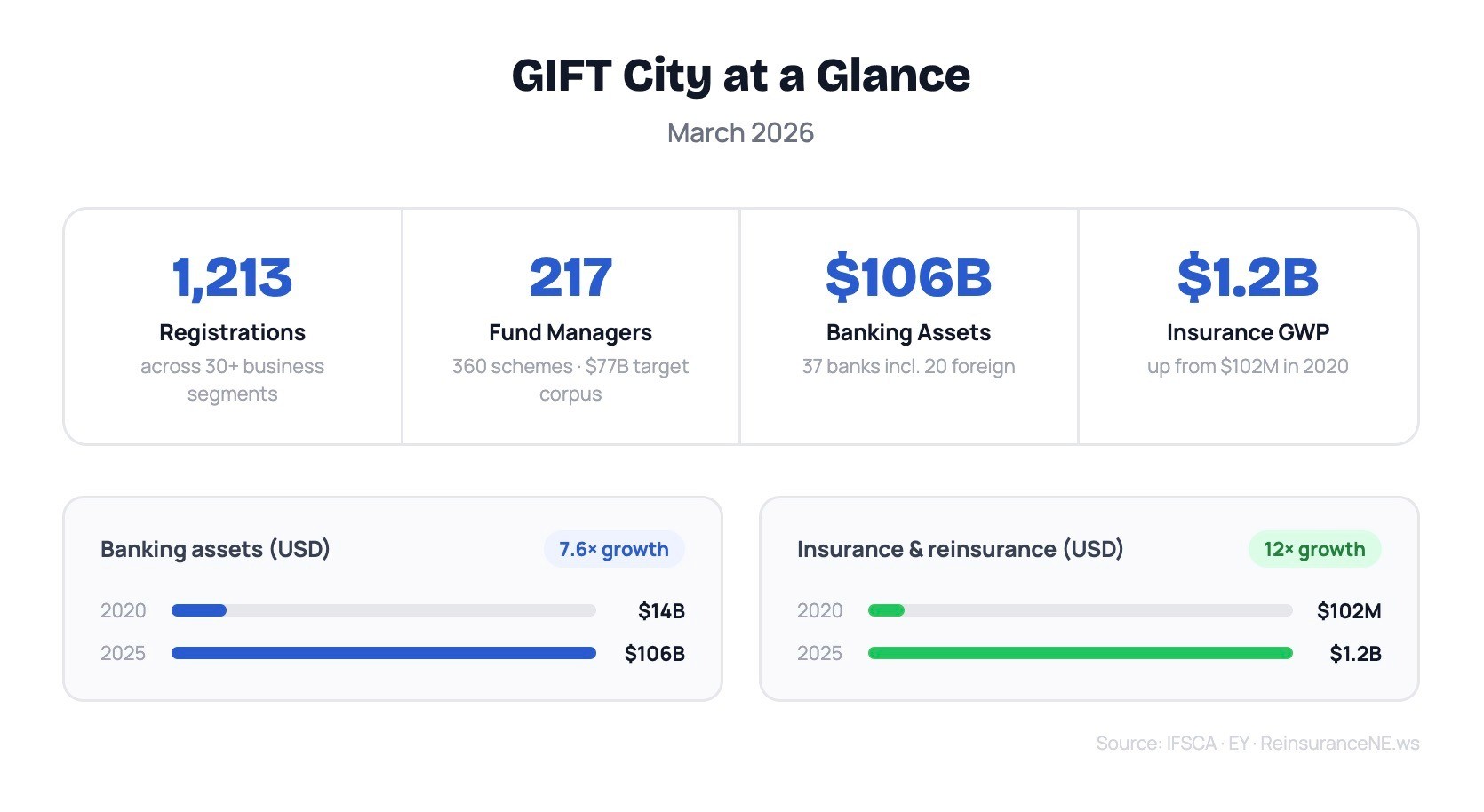
1,213 regulated entities. 217 fund managers. USD 106 billion in banking assets across 37 banks, including 20 foreign institutions. USD 39.09 billion in cumulative fund commitments.
A decade of policy reform had produced something real: a functioning international financial centre with genuine depth across banking, capital markets, fund management, insurance and leasing.
And yet the number of investors actually participating in this ecosystem is remarkably small relative to its scale and appetite.
The Untapped Retail Frontier
Out of nearly $39 billion in total fund commitments, retail schemes account for just $12.74 million across nine funds. Institutional investors continue to dominate the ecosystem, with approximately $32 billion in commitments and $15.5 billion already deployed.
This gap is not a reflection of absent demand, but of unrealised potential. If retail participation were to even modestly close the distance with institutional flows, it could unlock a significant new layer of capital and investors for the ecosystem, broadening GIFT City's base and deepening its relevance for a far wider segment of the market.
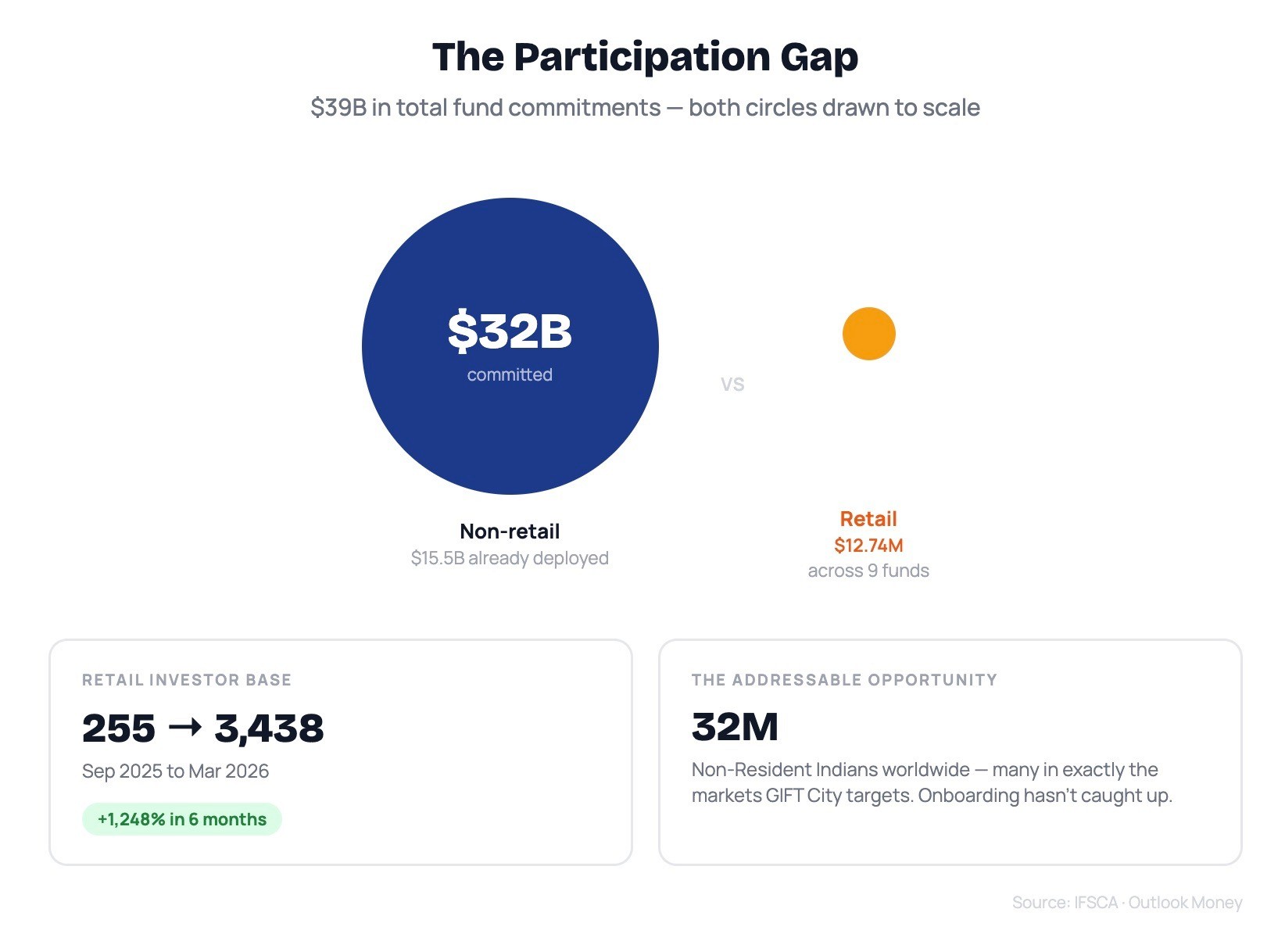
GIFT City was designed, in large part, to serve the 32 million Non-Resident Indians spread across the world's major financial centres. The US, UK, UAE, Singapore, Canada, Australia - these are the markets GIFT City has explicitly prioritised. The diaspora is financially sophisticated, and deeply connected to India.
The appetite for Indian financial products structured through a tax-efficient international centre should be enormous. And it actually is.
Then Where Does the Friction Exist?
For an investor looking to invest in India from outside the country, getting started is far from a typical onboarding process for a resident investor in India. The onboarding journey for such overseas investors typically spans 30 to 40 days - driven by a stack of paperwork, a journey not too familiar or easy to navigate without assistance.
All required documents are wet-ink executed in their country of residence. They need to be authenticated to meet the legal standards of both their home jurisdiction and India's regulatory framework.
Depending on where the investor lives, that means notarisation, apostille, certified translation, or some combination of all three. Every step involves a different authority. An embassy appointment or a notary visit. Documents couriered to GIFT Operation Center of the institutions.
The process wasn't designed to be difficult. It was just too operational for the digital, cross-border reality of the investors GIFT City was trying to reach.
50 to 60% of NRI account opening applications were stalling at the document authentication step alone.
The consequences showed up publicly. XED Executive Education attempted GIFT City's first-ever IPO, listed on NSE International Exchange and India INX. Strong retail interest. But NRI and foreign investors couldn't complete verification within the bidding window. The deadline was extended. It didn't help. The IPO closed at roughly 5% subscribed and was withdrawn.
GIFT City's most visible milestone had been derailed by a broken onboarding process.
The V-CIP Fix
IFSCA saw the problem and addressed it in layers: each regulatory change targeting a specific point of friction as it became visible.
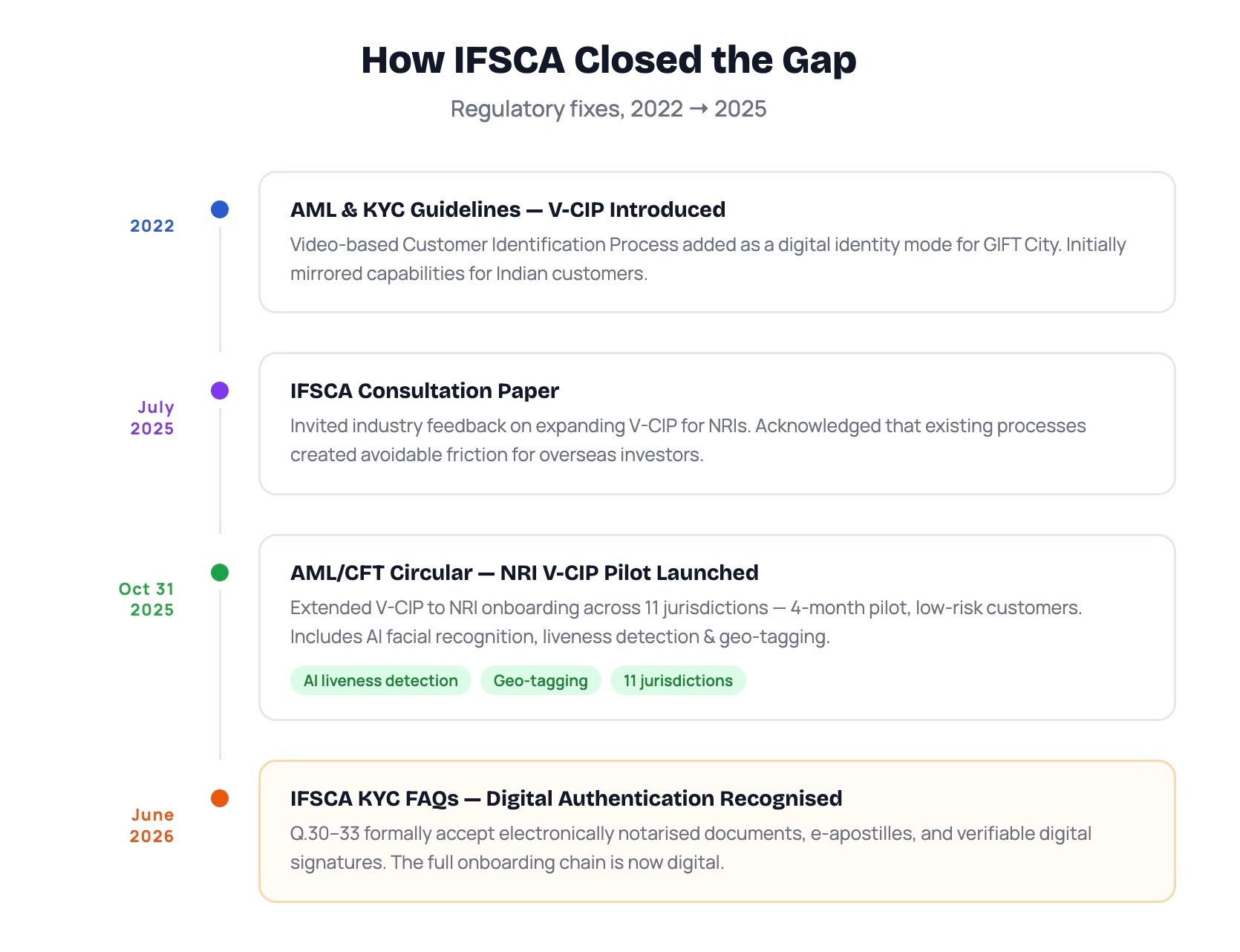
The 2022 AML and KYC Guidelines introduced V-CIP as a remote identity verification option. It was a start, but largely depended on ADHAAR and an active Indian mobile number - mechanisms inaccessible to most NRIs and OCIs. An NRI calling in from Dubai or Toronto still fell outside what the framework could handle.
By mid-2025, that gap was impossible to ignore. IFSCA published a consultation paper in July seeking feedback on extending V-CIP to NRIs, which was eventuallyformalised. V-CIP now covers NRI onboarding across 11 jurisdictions — the USA, UK, UAE, Singapore, Canada, Australia, Germany, France, Japan, South Korea and EU countries. Four-month pilot, low-risk customers only.
Remote identity verification, at scale, across the markets that matter. A real step forward.
But it only solved half the problem. An investor who passed video KYC still needed to authenticate supporting documents from outside India. That bottleneck remained.
How Rupeeflo Changed That
We had been building directly into this gap.
Our product: an e-notarisation solution that lets NRIs complete document authentication without visiting a notary or Indian embassy. No physical visits. No couriering. No two-week embassy appointments.
In early June 2026, we brought the solution to IFSCA at a Chintan Shivir 3.0 convened around GIFT City's 2031 vision. Onboarding came up as one of the central barriers to participation.
We pitched our existing solution that was built for global investors - a uniform-single journey for any investor located outside India.
Our pitch was simple: we'd already solved it for over 50 countries, which is already being utilized by all the leading Banks and Brokers and multiple financial institutions on the India side. GIFT City had the same problem with a different flag on it. Nine days later, on June 19, IFSCA published its KYC FAQ - recognising the acceptance of electronically notarised and e-apostilled documents by regulated entities registered with IFSCA in GIFT City.
Today, we proudly stand as the only platform whose digital onboarding workflow is fully aligned with and recognised by the IFSCA's framework and are also currently live with over 20 large financial institutions including banks and brokers
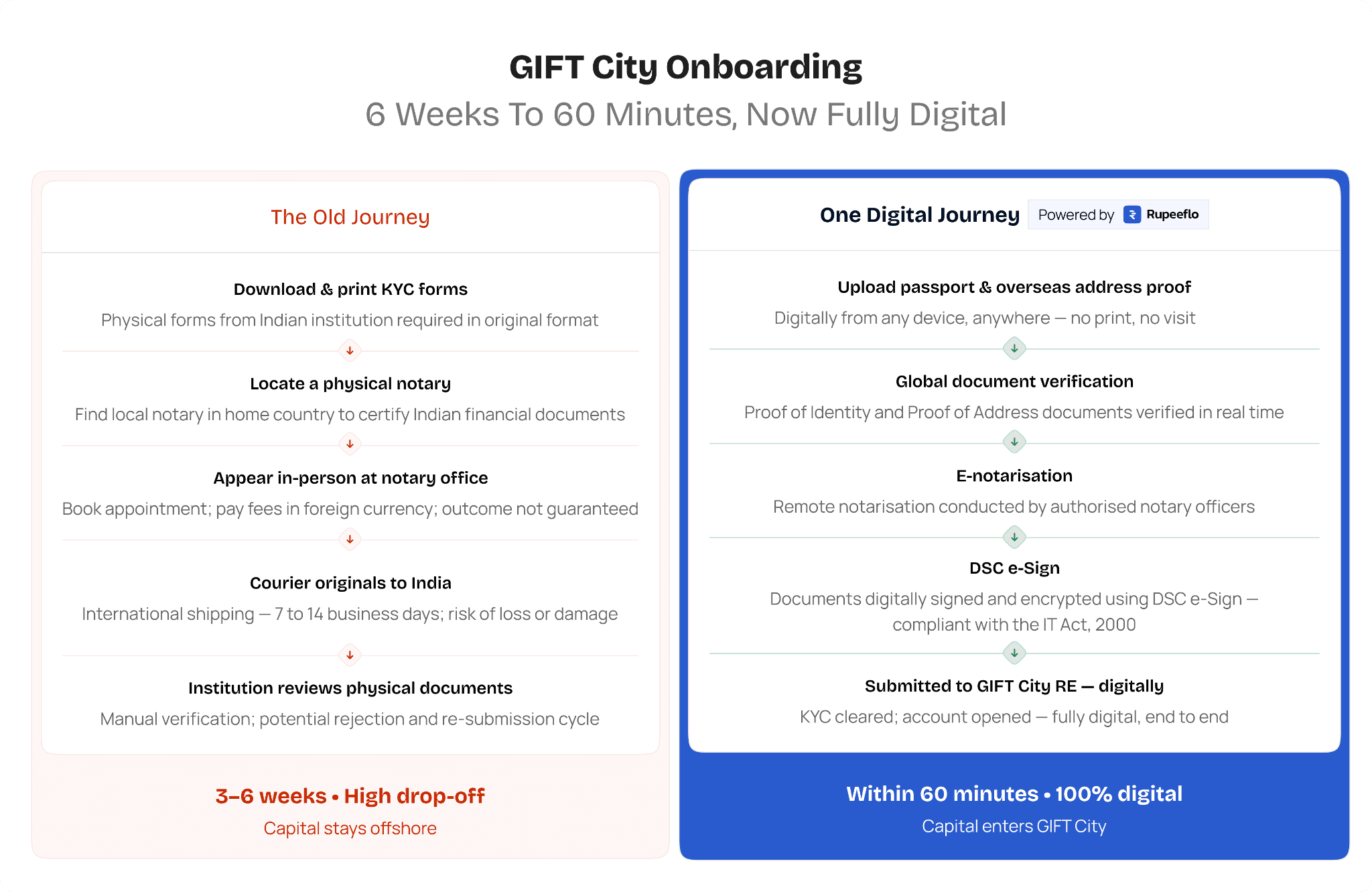
Those 32 million NRIs aren't waiting for a better product. The framework is ready. The digital path exists. The only question left is whether the institutions serving them have the infrastructure to deliver it.
If you're a bank, broker, or fund manager building in GIFT City, that's the conversation worth having. Reach out, and let's talk about how Nuvanta can close the onboarding gap for your investors.