

Investment
7 Mins

Apoorva K
Team Rupeeflo
Yes - if you're a foreign individual or foreign company that owns, or is about to own, shares in an Indian private company, you'll typically need an Indian demat account to hold those shares legally. Since 2023, the Ministry of Corporate Affairs has required private companies with paid-up capital over ₹10 crore or turnover over ₹100 crore to record ownership electronically instead of on paper share certificates, under the Companies (Prospectus and Allotment of Securities) Second Amendment Rules, 2023
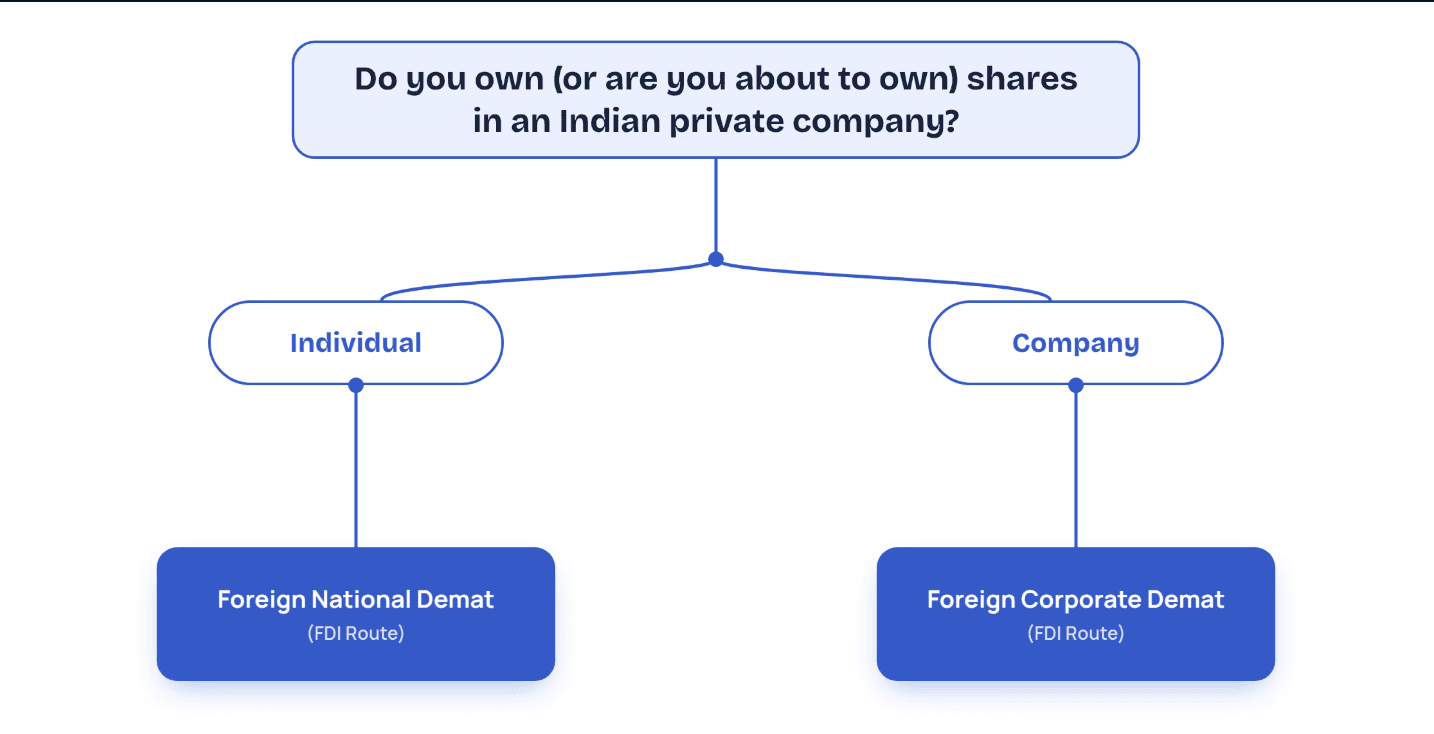
This commonly arises when foreign investors are investing in India through the FDI route. The exact account depends on whether the shareholder is an individual or a corporate entity.
Why do FDI investors need a demat account?
Because without it, there's no legal way to actually hold your shares in India.
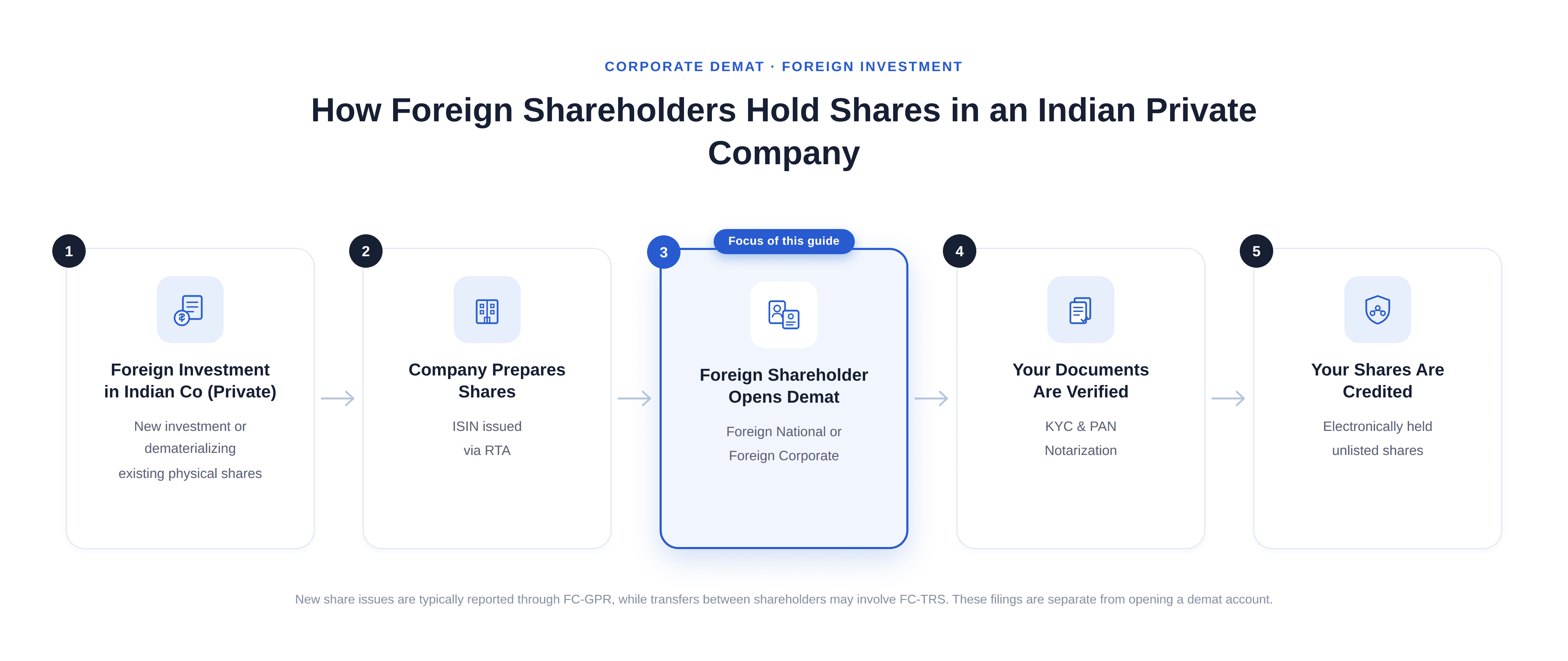
Under Rule 9B of the Companies (Prospectus and Allotment of Securities) Rules, 2014 most private companies now have to hold their securities electronically. Once a company falls under this rule (and most private companies eventually do) shares only count as yours when they sit in an electronic account, not on a certificate. That's true whether you're putting in fresh capital, buying shares off someone who already holds them, exercising ESOPs, or already hold shares that your company is now converting.
Skip this step and your investment isn't actually finished. The company can wire the money, file the paperwork, report it to the RBI, and none of that changes one fact: until the shares land in a demat account, you don't have anything you can point to as proof of ownership, or ever sell.
When do foreign shareholders need a demat account?
You typically end up needing this account one of two ways.
A/ You’re becoming a shareholder for the first time.
Maybe a fund or an angel is putting fresh capital into an Indian startup, in which case the company files an FC-GPR with the RBI.
Maybe you’re buying shares off someone who already holds them, a departing co-founder, an exiting early investor, in which case it’s an FC-TRS instead, since it’s a transfer rather than a fresh issue.
Maybe you’re a foreign employee who just exercised stock options, which makes you a shareholder the same way a fresh investment does.
B/ You already own shares, and your company has to move them into demat form.
This is Rule 9B. Companies had until June 2025 to convert their existing shareholders, or September 2026 if they crossed the size threshold more recently. Either way, you end up holding shares electronically.
Which demat account do you need?
It depends on who legally owns the shares.
If you’re… | You’ll typically need… |
Foreign company/parent investing in an Indian subsidiary | Foreign Corporate Demat |
Foreign VC or PE fund invested in an Indian startup | Foreign Corporate Demat |
Foreign founder holding shares directly in their own name | Foreign National Demat |
Foreign employee holding shares from exercised ESOPs | Foreign National Demat |
One legal shareholder = one demat account. If both a foreign company and one of its directors or partners hold shares directly, each opens the account appropriate to them.
One clarification worth making here: this is a different account from an NRI Demat Account or an FPI Trading Account. Those exist for NRIs and OCIs, and for SEBI-registered foreign portfolio investors trading listed Indian securities. If you’re holding unlisted shares in a private company through FDI, neither of those applies to you.
What documents are typically required?
Foreign National Demat mostly needs to establish who you are: a notarised passport, one form of notarised address proof, a FEMA declaration, and evidence of a foreign bank account. Since everything comes from you directly, it's usually the faster of the two to assemble.
Foreign Corporate Demat has to establish both the company and the people running it: a notarised Certificate of Incorporation and MOA/AOA, a board resolution, two years of financials, plus individual documents for every director. More moving parts, since you're verifying an entity and its signatories at the same time.
[Download the full checklist for your account type]
Where foreign shareholders usually get stuck
Opening a demat account is usually not the difficult part. The delay happens before the application reaches the depository participant - while getting foreign documents prepared in the format accepted in India.
For many foreign shareholders, the first hurdle is obtaining a PAN if they don’t already have one. Since PAN is required for the demat application, the account-opening process cannot move forward until this is completed.
The next challenge is document preparation. Foreign passports, address proofs, and corporate documents such as incorporation certificates, constitutional documents, and board resolutions need notarisation that can be accepted by the DPs based in India. Getting the format right is not always easy.
Physical submission of paperwork adds another layer of friction. After verification, documents often need to be couriered to India as originals. A missing signature, incorrect certification, or mismatch between documents can result in additional clarification requests and delays.
The most remote-friendly way to get this done
Every delay in the section above, the PAN application, the notarisation, the courier runs, is something our team sits through with you instead of you figuring it out alone from another country. Rupeeflo is an Authorised Person of Zerodha Broking, and for foreign shareholders and companies going through this, we handle the cross-border parts that usually cause the most delay.
A direct line to Zerodha
We route your account opening straight to Zerodha's onboarding team, so it moves quickly from the start.
Notarisation and courier, handled
Whether it's dematerialising existing shares, a fresh FDI investment, a share transfer, or an ESOP exercise, the paperwork needs notarised signatures and documents moving between your country and India. We arrange video call notarisation and courier the documents both ways.
One coordination thread
You're added to a dedicated group with our team, so questions on documents, status, or next steps land in one place.
Talk to Rupeeflo about your demat account
Share a few details below - our team will get in touch to walk you through the process.
Get started
FAQs
Is a Foreign National Demat account the same as an NRI Demat account?
No. An NRI Demat account is for NRIs and OCIs investing in listed Indian securities through the PIS or non-PIS route. A Foreign National Demat account is for foreign individuals holding unlisted shares in an Indian private company acquired through FDI. The document sets and the purpose are different, so one can’t substitute for the other.
Do I need a PAN before I can open a Foreign National or Foreign Corporate Demat account?
Yes. A PAN is required for both account types and needs to be in hand before the demat application goes in. If you don’t already have one for another reason, you’ll need to apply for one specifically for this.
What happens if my company hasn’t got an ISIN yet?
Then no shares can be credited into any demat account yet, even once it’s open. The ISIN is generated at the company level through its RTA and NSDL or CDSL, and it has to exist before shares, whether new, transferred, or converted from paper, can move into anyone’s account. This usually runs in parallel while shareholders complete their own KYC.
Is a Foreign Corporate Demat account the same as an FPI Trading Account?
No. An FPI Trading Account is for SEBI-registered Foreign Portfolio Investors trading or investing in listed Indian securities through a custodian. A Foreign Corporate Demat account is for a foreign company holding unlisted shares in an Indian private company through FDI. If your fund is registered as an FPI, this isn’t the account you need.