

Investment
7 Mins

Apoorva K
Team Rupeeflo
A foreign investor wants to buy shares of Infosys. Another wants to acquire a 30% stake in an Indian startup. A third wants to set up a wholly owned subsidiary.
The same investor can enter India through very different structures - but most foreign investments fall under one of two frameworks: Foreign Direct Investment (FDI) or Foreign Portfolio Investment (FPI).
That distinction affects the accounts you open, the regulators you deal with, the reporting requirements that apply, and how the investment is treated across its lifecycle. Before opening accounts, moving capital into India, or making any filings, it helps to know which route actually applies.
The sections below break down the difference and offer a simple framework to identify the right one.
FDI vs. FPI: What's the Difference?
While both FDI and FPI allow foreign capital to enter India, they are designed for very different investment objectives.
Foreign Direct Investment (FDI) is meant for investors looking to establish or own part of a business in India. This includes setting up a wholly owned subsidiary, investing in an unlisted startup, forming a joint venture, or acquiring a significant stake in a listed company. FDI is typically associated with long-term ownership and greater involvement in the business.
Foreign Portfolio Investment (FPI) is designed for investors seeking financial returns from India's capital markets without participating in day-to-day management. It allows eligible foreign investors to invest in listed shares, bonds, government securities, ETFs, REITs, and other market-linked instruments while remaining a passive investor.
The biggest distinction is simple:
Choose FDI when you're investing in a business.
Choose FPI when you're investing through the stock market.
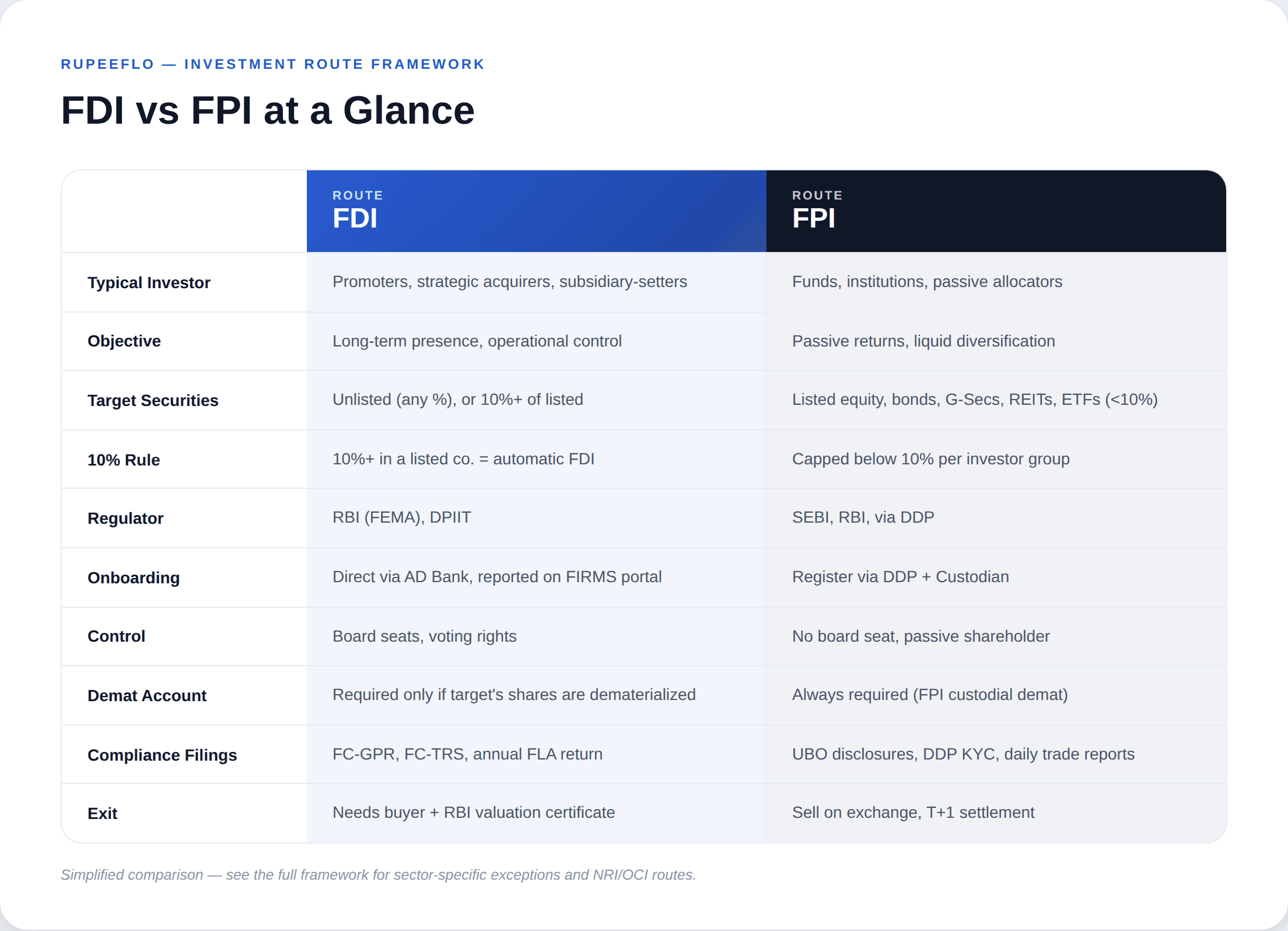
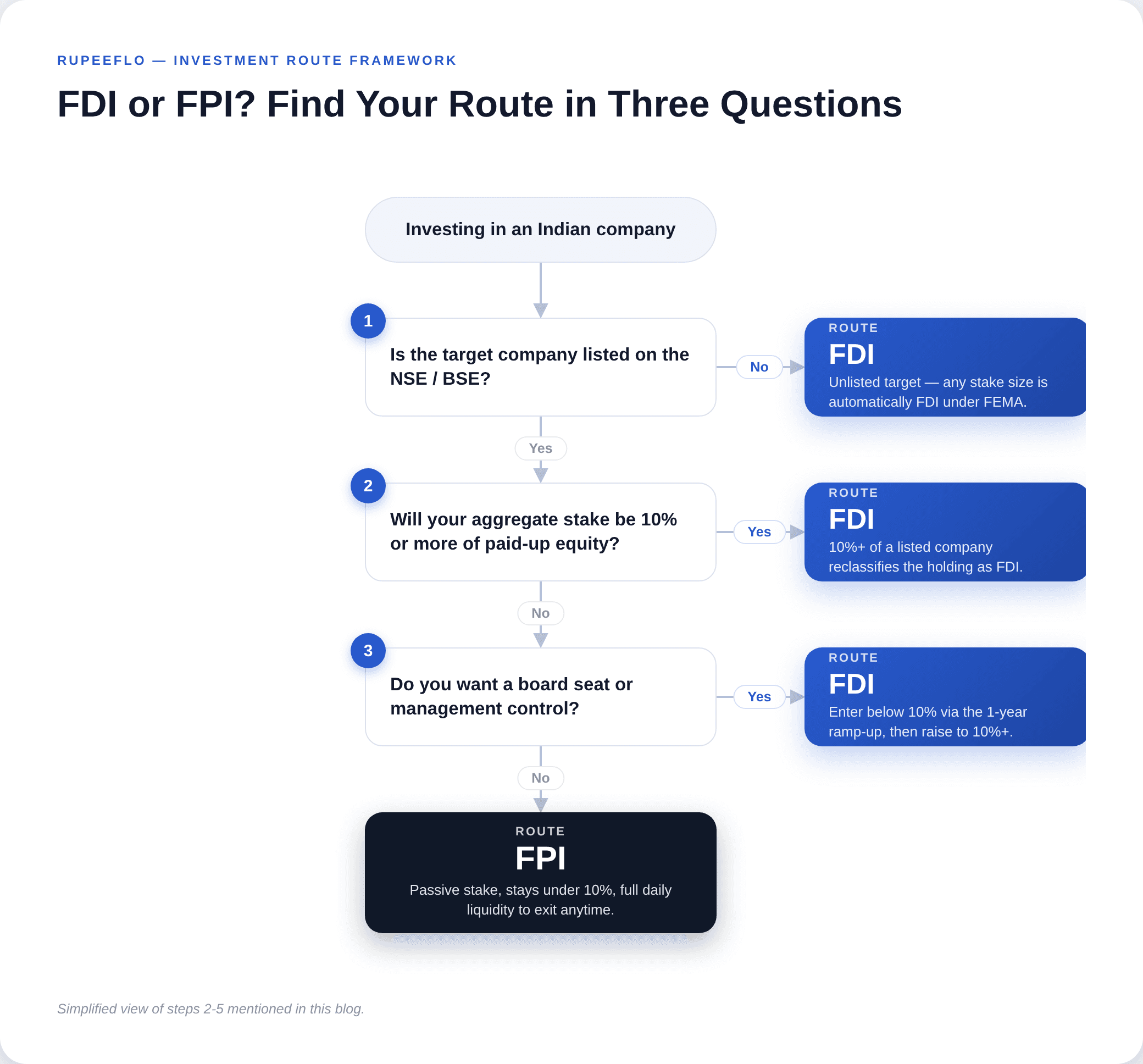
How to Choose Between FDI and FPI: A 5-Step Decision Framework
Step 1: What Are You Investing In?
The type of asset you're investing in is the first filter.
If you're buying listed financial instruments such as shares, bonds, ETFs, REITs or InvITs, your investment will generally follow the FPI route.
If you're investing directly into an Indian business (whether that's a startup, a private limited company, a joint venture, or a wholly owned subsidiary) your investment will generally follow the FDI route.
You’re investing in | Investment Route |
Listed shares | FPI |
Corporate bonds | FPI |
Government Securities | FPI |
ETFs | FPI |
REITs / InvITs | FPI |
Startup | FDI |
Private Limited Company | FDI |
Joint Venture | FDI |
Wholly Owned Subsidiary | FDI |
For most investors, this first question immediately narrows the applicable framework. Listed market instruments generally fall under FPI, while direct ownership in an Indian business falls under FDI.
Step 2: Is the Indian Company Listed or Unlisted?
The next question is where your investment is going.
Foreign investments into unlisted Indian companies and listed Indian companies are treated differently under India's foreign investment framework.
If you're investing in an unlisted company (such as a startup, private limited company, or wholly owned subsidiary) the investment is classified as FDI, regardless of the size of your stake.
If you're investing in a listed company, ownership percentage becomes the deciding factor. Under FEMA, a foreign investment of less than 10% is generally classified as FPI, while a holding of 10% or more is classified as FDI.
A holding of less than 10% is generally classified as FPI.
A holding of 10% or more is generally classified as FDI.
Company Type | Ownership | Investment Route |
Unlisted company | Any % | FDI |
Listed company | Less than 10% | FPI |
Listed company | 10% or more | FDI |
What Happens if a Listed Investment Crosses 10%?
When a foreign investor’s holding in a listed Indian company goes to 10% or more, the investment can’t remain under the FPI route. At that point, the investor has five trading days from settlement to take either of the following actions:
Sell down the excess stake, i.e. reduce the holding below 10%; or
Switch the entire holding into the FDI framework and follow the relevant pricing, sectoral, and reporting rules.
Here, two exceptions are worth keeping in mind.
First, an investor may begin as FDI with a holding below 10%, as long as the stake reaches 10% or more within one year of the first purchase. If not raised within a year, the investment is reclassified as a portfolio investment.
Second, if an existing FDI holding drops below the 10% mark (e.g., due to stock dilution or partial sales), it continues to be treated as FDI without any obligation to restore it to 10%.
Step 3: Do You Need Operational Control?
The next question is how involved you want to be in the business.
Investments made to establish a business, acquire a strategic stake, appoint directors, or participate in management generally follow the FDI framework.
Investments made primarily for market exposure and financial returns generally follow the FPI framework.
Investment Objective | Route |
Board Representation | FDI |
Strategic Ownership | FDI |
Management Participation | FDI |
Portfolio Investment | FPI |
Step 4: Who Is Making the Investment?
The identity of the investor determines the regulatory route available.
Foreign Corporations / Parent Companies: Use the FDI route to fund Indian subsidiaries, launch joint ventures, or acquire strategic corporate holdings.
Institutional Funds (Pension Funds, Sovereign Wealth, Mutual Funds, Family Offices): Register as FPIs via a Designated Depository Participant (DDP) to trade listed Indian equities, government bonds, corporate debentures, and REITs.
Non-Resident Indians (NRIs) & Overseas Citizens of India (OCIs): Neither corporate route applies directly! When deploying personal capital into listed Indian securities, you operate under dedicated FEMA provisions (Schedule III on a repatriation basis or Schedule IV on a non-repatriation basis), distinct from corporate FDI/FPI rules.
Step 5: How Important Is Liquidity?
The final question is how you expect to exit the investment.
FPI investments are designed for exchange-traded securities that can generally be bought and sold through recognised stock exchanges. Since FPIs trade publicly listed shares, you can sell your holdings on the stock exchange during market hours and wire the funds abroad through your custodian bank as soon as the trade settles (T+1 days).
FDI investments represent direct ownership in an Indian business. Exiting an FDI investment isn't instant; you cannot just sell on an open exchange. You need to find a buyer, get an official valuation certificate to ensure the sale price meets RBI's mandatory minimum/maximum limits, and complete regulatory bank filings before wiring funds out of India.
What Happens After You Choose FDI or FPI?
Once you identify the correct route, the day-to-day administrative workflow shifts significantly. Here is what changes on your desk across both routes.
Who Regulates FDI and FPI?
FDI Framework: Primarily governed by the Reserve Bank of India (RBI) under FEMA regulations, along with policy frameworks issued by the Department for Promotion of Industry and Internal Trade (DPIIT). You execute transfers directly through an Authorised Dealer (AD) Category-I Bank in India, which acts as the regulatory gatekeeper for inward remittances and reporting.
FPI Framework: Governed primarily by the Securities and Exchange Board of India (SEBI), alongside RBI exchange control rules. Instead of dealing directly with government departments, you register through a Designated Depository Participant (DDP), who acts as SEBI's onboarding authority, and appoint an authorized domestic Custodian.
What Are the Compliance Requirements?
FDI Compliance Path (Driven by FEMA & Company Law)
The Indian company must allot shares within 60 days of receiving the foreign investment.
File Form FC-GPR within 30 days of share allotment through the RBI's FIRMS Portal.
File Form FC-TRS within 60 days of any share transfer between a resident and a non-resident.
Submit Annual Foreign Liabilities and Assets (FLA) Return directly to the RBI by July 15 of the reporting year.
FPI Compliance Path (Driven by SEBI & Local Custodians)
Maintain accurate KYC and Ultimate Beneficial Ownership (UBO) disclosures through your DDP.
Keep KYC information updated whenever there are material changes.
Trade settlement and position reporting are managed through your local custodian in accordance with SEBI and depository requirements.
Comply with Indian tax reporting requirements, including those relating to capital gains and dividend taxation.
Do You Need a Corporate Demat Account?
For FPI: Yes, required. An FPI cannot hold physical securities or operate without an electronic account. Every FPI must open an FPI-designated corporate demat account tied directly to its SEBI registration, DDP, and local custodian bank.
For FDI: Conditional. If you invest in an Indian company whose shares are dematerialized (particularly for most private limited entities under Ministry of Corporate Affairs rules), you will need to open a corporate FDI demat account with an Indian Depository Participant (NSDL/CDSL) to receive those shares electronically. However, if the target entity is an unlisted private company issuing physical paper certificates, a demat account is not strictly required.
Common FDI and FPI Mistakes Foreign Investors Make
Even after you’ve picked the right route, execution mistakes can freeze remittances, trigger RBI queries, or unwind months of paperwork. Here are the five most common ones.
1. Remitting Funds Before AD Bank Verification
Many investors wire capital into India before their Authorised Dealer (AD Category-I) Bank has reviewed the corporate structure, KYC, and Ultimate Beneficial Ownership declaration. Funds that arrive without prior clearance can get frozen or misclassified under the wrong FEMA purpose code, which delays share allotment and invites RBI scrutiny. Clear your paperwork with the AD Bank before you remit, not after.
2. Ignoring RBI Pricing and Valuation Rules
Foreign investors sometimes agree on a share price purely on commercial terms, without checking RBI’s Fair Market Value rules under FEMA. Inward FDI shares can’t be priced below the FMV certified by a CA or IBBI valuer, and exits to Indian residents can’t go above that same ceiling. Get the valuation certificate before you agree on price, not after the deal is signed.
3. Overlooking Sectoral Caps and Press Note 3
Not every sector allows 100% foreign ownership automatically - regulated sectors like defense, media, and satellite carry lower caps or need prior approval. Separately, if any beneficial owner is based in a country that shares a land border with India, Press Note 3 requires government approval before you remit, regardless of sector. Check both before signing deal terms, not after.
4. Mixing Corporate and Personal Investment Accounts
Funding a corporate investment through an individual NRI or OCI account might look like a shortcut past onboarding paperwork. It isn’t one. Individual NRIs operate under FEMA’s Schedule III or IV; foreign corporations and institutional funds need their own dedicated Corporate FDI or FPI custodial demat accounts. Keep personal and corporate capital in separate lanes.
5. Missing the 10% Reclassification Window
This one catches FPI investors specifically. If your aggregate holding in a listed company reaches 10% through a secondary market trade or a corporate action, you have five trading days from settlement to either sell down below 10% or formally reclassify the entire holding as FDI. Miss that window and you’re not just late on paperwork - you’re out of compliance.
How Rupeeflo Helps Foreign Investors Invest in India
Once you know your route, the next step is opening the right corporate demat account and getting the paperwork right before any capital moves.
Rupeeflo helps foreign companies, institutional funds, and other corporate investors open the FDI or FPI demat account their structure requires - without chasing requirements across separate banks, brokers, and depositories on your own.
Talk to Rupeeflo About Your India Entry →
Frequently Asked Questions
Are FDI and FPI the Same as FII?
No, though the confusion is common. FII (Foreign Institutional Investor) is an older term largely replaced by FPI under current regulations. FDI and FPI remain distinct; one is business ownership, the other is portfolio investment.
Does the 10% Rule Apply to REITs and InvITs?
No. FPIs can hold REIT and InvIT units without the usual 10% cap that applies to listed company shares; this is a specific exception under SEBI's FPI framework, not a general rule.
What Happens If My FPI Holding Crosses 10%?
No penalty on the investment itself, but you get 5 trading days from settlement to either sell down below 10% or formally reclassify as FDI; missing that window creates a compliance issue, not a loss of funds.
Can a Foreign VC Fund Invest in an Indian Startup Through FPI?
No. Unlisted company investments are always FDI, regardless of stake size or investor type; the FPI route only exists for listed (or soon-to-be-listed) securities.
Can an FPI Investment Be Converted into FDI?
Yes. If an FPI group's aggregate holding in a listed entity touches or passes 10%, you can formally reclassify the entire holding as FDI, provided you comply with sectoral caps, pricing rules, and RBI disclosures.
Can the Same Foreign Investor Use Both FDI and FPI?
Yes. A foreign investor can invest through both the FDI and FPI frameworks, provided each investment independently complies with the applicable regulations. However, the same investment in a particular company cannot simultaneously be classified under both routes.