

Investment
5 Mins

Apoorva K
Team Rupeeflo
What Can You Actually Invest In Through GIFT City?
Quick answer:
GIFT City isn’t one product! It’s four separate categories, each with its own provider and its own way in.
Hold USD without committing to anything | Savings Account |
Earn a fixed, predictable return | Fixed Deposit |
Buy US stocks | India INX GAP or NSE IX (UDRs) |
Grow money without picking stocks yourself | Mutual Funds |
High-net-worth, tailored investing | PMS |
Private equity / hedge-fund-style strategies | AIF |
Everything below explains why, and which one actually fits your situation.
Say you’ve just sold some US stocks and have USD sitting in your brokerage account. You’re not ready to reinvest it yet, and you don’t want to convert it to INR just to park it. That’s exactly the situation GIFT City’s foreign currency accounts were built for - and it’s one of a dozen different things people lump together under the umbrella term “GIFT City.”
That’s the confusion this guide clears up. GIFT City is India’s International Financial Services Centre (IFSC) — a single regulatory zone where banks, stock exchanges, fund managers, and insurers all operate side by side, each offering completely different products. IFSCA regulates all of them, but a bank account, a US stock trade, and a private equity fund are three unrelated things that happen to share a zip code.
By the end of this guide, you’ll know:
What you can actually invest in through GIFT City — and what you can’t
Who offers each product, and who it’s actually built for
How to combine products based on your own situation, not a generic recommendation
Key terms, fast
How the Ecosystem Actually Fits Together
Four types of institutions operate inside GIFT City, and each does one job.
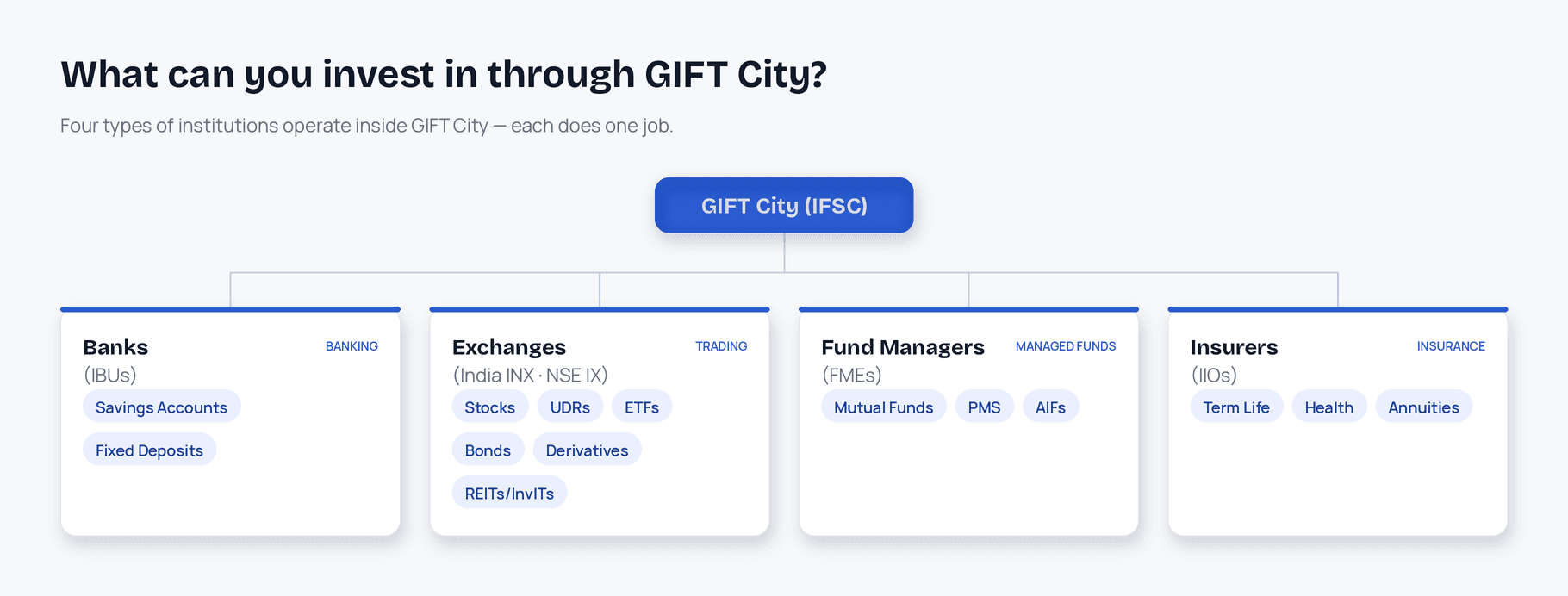
You don’t open one “GIFT City account” that unlocks all of this. You pick the specific product (a savings account, a brokerage account, a fund), and onboard with whichever institution offers it. Now let’s go through each branch.
Banking Products: Where to Park Money Before You Decide
Not everyone opening a GIFT City account wants to start investing immediately. Sometimes, you simply want a place to park your USD without converting it to INR. That's where IFSC Banking Units (IBUs) come in. GIFT City branches of banks like HDFC, ICICI, Axis, IndusInd, IDFC FIRST, and Federal Bank - are built for this specific use case.
Savings Accounts: A foreign currency account. Hold USD (and other eligible currencies), earn interest, pay or invest directly - no INR conversion needed.
Good for: parking money before you decide what’s next
Skip if: you’re chasing long-term growth, not just holding cash
Fixed/Term Deposits: Lock in your money for a set period at a fixed rate. HDFC, ICICI, and Axis all offer IBU term deposits.
Good for: predictable returns while staying in foreign currency
Skip if: you might need the money soon, or want market-linked growth
Eligible currencies, tenure, rates, and overdraft facilities vary by bank — check the bank’s own page for current terms.
Exchange-Traded Products: Investing Directly in Markets
Say you’d rather own an actual slice of Apple or NVIDIA than sit in a savings account. GIFT City gives you two exchanges for this: India INX (BSE-promoted) and NSE IX (NSE-promoted). You’ll need a trading account with an IFSCA-registered broker connected to one of them.
Stocks: Direct ownership, bought fractionally through India INX’s Global Access platform, routed under RBI’s Liberalised Remittance Scheme (LRS) — meaning it counts against your $250,000/year limit.
Good for: long-term investors who want actual ownership
Skip if: you want stable returns, or prefer someone else managing the picks
Note: availability depends on specific listings and your broker’s connectivity — not every global stock is tradable here yet
Depository Receipts (UDRs): NSE IX’s Unsponsored Depository Receipts track the price of roughly 50 US stocks (Apple, Amazon, Microsoft, Meta, Tesla, Alphabet) without you owning the underlying share — a custodian bank holds it for you. Unlike GAP, this route doesn’t draw down your LRS limit.
Good for: affordable exposure to specific US names without a foreign brokerage account
Skip if: you want full shareholder rights or the widest possible stock universe — NSE IX has said it plans to expand the list, but it’s not there yet
Why the same stock shows up in both rows above: GAP gives you direct ownership and uses your LRS limit. UDRs give you price exposure without owning the share, and don’t touch your LRS limit. Which one makes sense depends on how much of your $250K you’ve already committed elsewhere.
ETFs: Track an index or sector (Nifty 50, S&P 500) and trade like a stock.
Good for: one-trade diversification
Skip if: you want active management or guaranteed returns
Bonds & Debt Securities: Lend money to an issuer, get regular interest. NSE IX and India INX both list foreign currency, masala, and green bonds — for example, Indian Oil’s foreign currency bonds.
Good for: steady income, portfolio stability
Skip if: you’re chasing growth, not income
Derivatives: USD-denominated contracts on Nifty 50 futures, GIFT Bank Nifty, and GIFT Nifty Financial Services — see NSE IX’s own listings for current contracts.
Good for: experienced traders hedging or taking short-term positions
Skip if: you’re new to this, or investing passively
REITs & InvITs: Pooled real estate/infrastructure trusts — no direct property ownership. IFSCA permits REITs/InvITs already listed in India, the US, Japan, South Korea, the UK (excluding British Overseas Territories), France, Germany, and Canada to also list on GIFT IFSC.
Good for: income-focused investors wanting real estate/infra exposure without buying property
Skip if: you expect fast capital gains or need daily liquidity
Professionally Managed Products: Let Someone Else Pick
Say you want the diversification of investing without spending your weekends picking individual stocks. Fund Management Entities (FMEs) registered with IFSCA run three products here — they mainly differ in how much money you need and how locked-in it is.
Mutual Funds: Pooled money, professionally managed. Most start at USD 5,000, though some retail schemes — like the Tata India Dynamic Equity Fund — launched at USD 500.
Liquidity: easiest of the three; open-ended funds redeem anytime
Good for: diversification without a large upfront commitment
Skip if: you want to pick individual securities yourself
PMS: A portfolio manager builds you a custom portfolio. Minimum investment is USD 75,000, reduced by IFSCA from $150,000 in February 2025.
Liquidity: no fixed cycle — depends on your specific holdings
Good for: investors who want a tailored strategy and can meet the higher threshold
Skip if: you have a smaller amount to invest, or prefer hands-off investing
AIFs: Pooled vehicles for private equity, venture capital, private credit, or hedge-fund-style strategies. Minimum investment is USD 150,000 as of mid-2026 — this figure is set by IFSCA and can change, so confirm the current threshold before committing.
Liquidity: lowest of the three — money is typically locked in for a set period
Good for: investors comfortable with higher risk and longer holding periods
Skip if: you might need the money back on short notice, or are new to investing
What You Can’t Invest In Through GIFT City
Before opening a GIFT City account, it's worth knowing what you can't do. Since GIFT City operates under a separate regulatory framework focused on foreign-currency products, several investments available in India's domestic markets aren't available here.
Regular Indian mutual funds: GIFT City has its own IFSCA-regulated mutual funds, separate from SEBI-regulated domestic schemes. You can’t access your existing domestic MF portfolio through GIFT City.
NSE/BSE-listed Indian stocks: India INX and NSE IX trade global stocks and GIFT-specific derivatives, not domestic Indian equities.
Domestic real estate: GIFT City REITs give you exposure to real estate trusts, not direct property purchase.
Cryptocurrency: explicitly not permitted. IFSCA has stated that crypto-assets, and instruments with crypto as the underlying, aren’t allowed in GIFT IFSC.
Physical gold: no gold-buying products through GIFT City banking or exchange products.
Indian IPOs: IPO access through GIFT City is a separate, developing framework, not the same as applying for a domestic IPO through your regular demat account.
Other Financial Services in GIFT City
International Insurance: USD-denominated term life, health, and annuity plans from International Insurance Offices (IIOs), subject to availability.
Structured Products: Custom instruments combining market-linked assets and derivatives - equity-linked, index-linked, inflation-linked, or fixed-income structures.
Masala & Green Bonds: Rupee-denominated bonds listed in IFSC - still subject to the issuer’s own terms and home-jurisdiction rules.
Eligibility and compliance vary by product and by where you live. KYC, FATCA, and CRS reporting apply across the board. If you’re a US person, expect extra complexity - PFIC reporting for fund structures, on top of standard FATCA obligations. Talk to a cross-border tax advisor before committing meaningful money; this guide can’t substitute for that.
Putting It Together: One Example
Rahul is an NRI with $40,000 to deploy. He doesn’t want it all locked up, but he’s comfortable taking some risk with part of it.
$10,000 → Savings Account, for anything he might need access to quickly
$20,000 → Mutual Funds, for diversified, professionally managed growth
$10,000 → ETFs, for direct market exposure without picking individual stocks
That’s one combination. The right one for you depends on your own timeline, risk tolerance, and how much you want to manage yourself — which is exactly what the table below is for.
Quick Decision Table
Hold USD before deciding | Savings Account | You’re chasing long-term growth |
Earn steady returns on idle cash | Fixed Deposit | You may need the money soon |
Own individual companies directly | Stocks (GAP) | You prefer professional management |
Get exposure to specific global names | UDRs | You want direct ownership or the widest stock choice |
Diversify in one trade | ETFs | You want active management or guaranteed returns |
Add stable income | Bonds & Debt Securities | You’re chasing growth, not income |
Trade actively or hedge | Derivatives | You’re a beginner or passive investor |
Get real estate/infra exposure | REITs/InvITs | You expect fast gains or need daily liquidity |
Grow money without picking stocks | Mutual Funds | You want full control over security selection |
Get a tailored portfolio | PMS | You have a smaller amount, or prefer hands-off |
Access private equity/hedge strategies | AIF | You may need the money soon, or are new to investing |
Combining Products
Most investors don’t pick just one.
Build an emergency fund while earning interest | Savings Account → Fixed Deposit |
Balance safety and long-term growth | Fixed Deposit → Mutual Funds |
Grow wealth with professional management | Savings Account → PMS or AIF |
Mix active and passive investing | Mutual Funds + Stocks/ETFs |
Build a diversified portfolio | Fixed Deposit + Mutual Funds + Stocks + Insurance |
How to Actually Open an Account
Banking (Savings Account / FD):
Choose a bank with an IFSC Banking Unit (HDFC, ICICI, Axis, IndusInd, IDFC FIRST, Federal Bank)
Complete digital KYC — passport, PAN, overseas address proof
Fund via wire transfer or LRS remittance
Typical turnaround: a few business days once documents are verified
Brokerage (Stocks / UDRs / ETFs):
Open a trading account with an IFSCA-registered broker connected to India INX or NSE IX
Complete KYC and link a funding account
Fund via LRS (for GAP) or your GIFT City banking channel (for UDRs)
Mutual Funds / PMS / AIF:
Choose an IFSCA-registered FME
Complete KYC and, for PMS/AIF, provide accreditation or net-worth documentation
Remit the minimum investment via LRS or from an NRE/foreign account
Fees, exact documents, and timelines vary by FME — confirm directly before committing
Start Your GIFT City Journey with Rupeeflo
Rupeeflo can help eligible NRIs open a GIFT City banking account digitally through our partnership with leading Indian banks such as IDFC FIRST Bank, ICICI, HDFC Kotak, Axis etc - including the KYC and onboarding steps above.
You can register your interest here!
If you’re deciding between GIFT City and other places to park your savings, our comparison guide covers HYSA, NRE Deposits, and FCNR Deposits side by side. And if you’re weighing GIFT City stocks or funds against opening an NRI demat account for the Indian market, that’s worth reading too - the two aren’t mutually exclusive.
This article is for informational purposes only and isn’t investment or tax advice. Product availability and regulations change - verify current details with the relevant bank, broker, fund manager, or insurer before investing.
FAQs
Is GIFT City only for high-net-worth investors?
No. Savings accounts, fixed deposits, and many mutual funds start well within reach of most NRIs. PMS and AIFs are the only products with high minimums.
Do I need separate accounts for different GIFT City products?
Usually, yes. Banks, brokers, and fund managers each run their own onboarding — there’s no single “GIFT City account” that covers everything.
Can US-based NRIs invest in every GIFT City product?
Not automatically. Some products carry extra reporting obligations for US persons, including PFIC and FATCA. Check eligibility and tax treatment before investing, ideally with a cross-border tax advisor.
Do I need to convert my USD into INR before investing through GIFT City?
No. Most products are available directly in USD or other foreign currencies.
Can NRIs from any country invest in GIFT City?
Broadly yes, though specific products may carry country-level restrictions or extra documentation depending on your country of residence. Always confirm with the specific bank, broker, or fund manager.
What happens to my GIFT City investments if I move back to India?
Your holdings don’t disappear, but your tax residency status changes what applies to you going forward — worth checking with a tax advisor at the time, since rules depend on your specific situation.
How do I open a GIFT City bank account online?
Most IBUs offer fully digital onboarding — PAN, passport, and overseas address proof submitted online, with account activation typically within a few business days. See the step-by-step above.