

Investment
6 Mins

Apoorva K
Team Rupeeflo
The Short Answer
Yes. FCNR interest is taxable in the US.
India does not tax interest earned on FCNR deposits by NRIs, but the US generally taxes that interest as ordinary income if you're a US citizen or US tax resident. You report the interest for the year it is credited to your account, even if the FCNR deposit itself doesn't mature for another year or two.
This applies to US citizens, green card holders, and most people who qualify as US tax residents under the IRS's substantial presence test.
Not sure whether you're a US tax resident? The rules can be different for people who are new to the US or are on visas such as F-1. If that's your situation, confirm your tax status before applying the rules in this guide.
If you're deciding whether FCNR still makes sense after US taxes, Where Should US NRIs Park Their Savings? compares the after-tax returns of FCNR, NRE deposits, US HYSAs and GIFT City options.
How the IRS Actually Taxes FCNR Interest
For US tax purposes, FCNR interest is treated like other ordinary interest income. There is no special lower US tax rate just because the deposit is tax-free in India.
You pay tax at your applicable federal income tax rate, based on your overall taxable income. The same principle applies to interest earned from a US savings account or CD.
For example, if your FCNR deposit earns $1,000 in interest during the year, that $1,000 is generally included in your US taxable income for that year. It doesn't matter that the money stays in India or that you haven't transferred the interest to your US account.
You should report the interest using your Indian bank's statements or other records showing how much interest you earned and when it was credited.
Why You Can't Claim a Foreign Tax Credit on FCNR Interest
You might expect the US-India tax treaty to prevent this kind of double taxation. It doesn't, at least not for this. Almost every US tax treaty, including this one, has a rule called a saving clause: it lets the US keep taxing its own citizens and residents under normal US law, no matter what the rest of the treaty says elsewhere. That's what stops you from using the treaty's interest-income provision to lower US tax on FCNR interest specifically.
Normally, a foreign tax credit can help when the same income is taxed in both countries. If you pay tax to India on foreign income, you may be able to use that tax to reduce your US tax bill, subject to the IRS's rules. Foreign tax credit is actually one of the few treaty provisions that still applies to US citizens and residents despite the saving clause.
But FCNR interest has a catch: India doesn't tax it for NRIs. So there is no Indian tax to claim as a credit, even though the credit mechanism itself would otherwise be available to you.
That's why FCNR and NRO deposits can look very different from a US tax perspective:
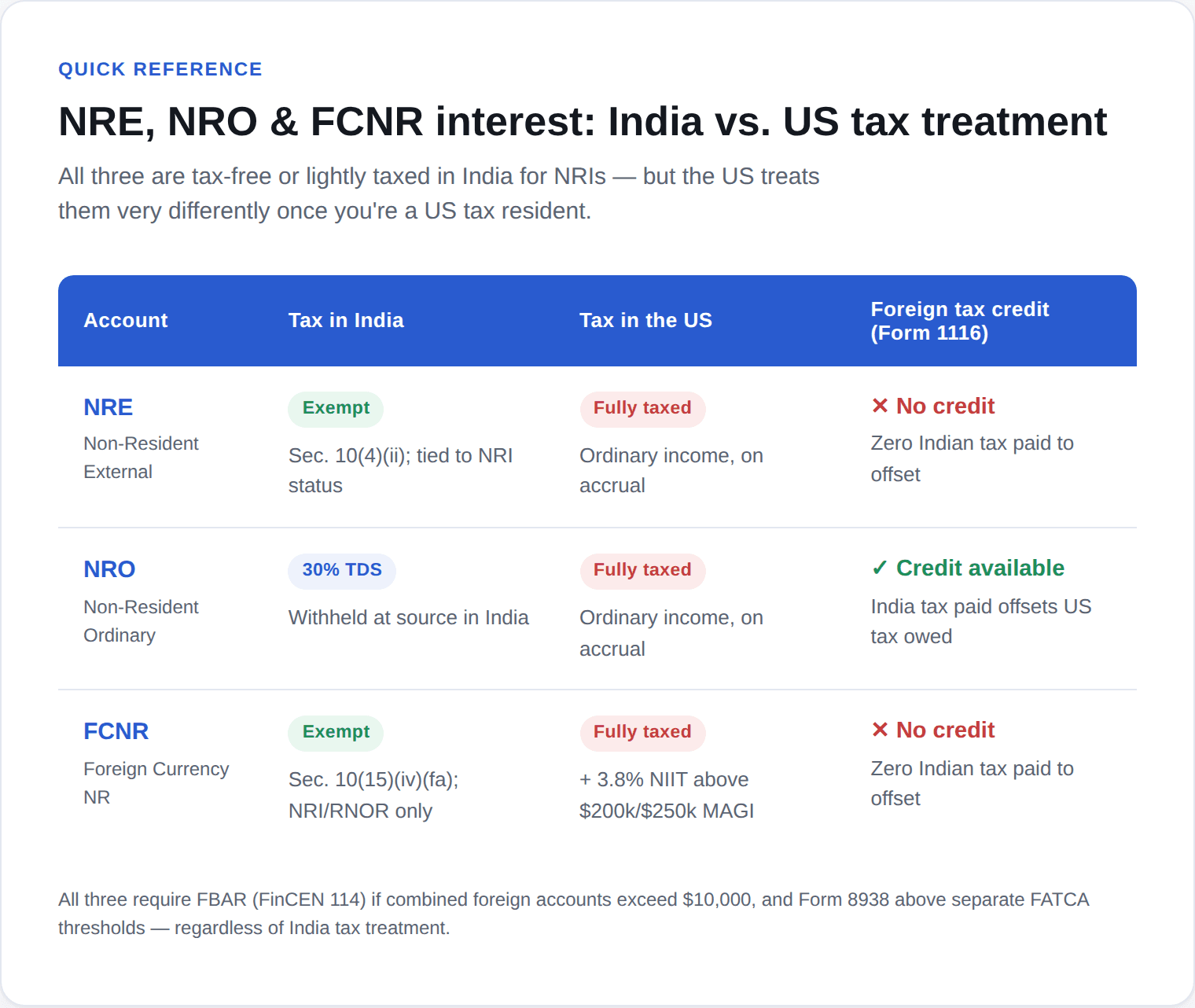
So while FCNR's tax-free status in India makes it attractive, it also means there's no Indian tax payment available to offset your US tax bill. The saving clause is why the treaty can't step in here, and even its one surviving workaround, foreign tax credit, has nothing to work with when India isn't taxing you to begin with.
How Much US Tax Will You Actually Owe?
The amount depends on your marginal federal tax bracket.
For example, if your FCNR deposit earns $5,000 in interest and that entire $5,000 falls within your 24% marginal bracket, you’d owe about $1,200 in federal income tax on it.
FCNR interest | Marginal tax rate | Approx. federal tax |
$5,000 | 12% | $600 |
$5,000 | 22% | $1,100 |
$5,000 | 24% | $1,200 |
$5,000 | 32% | $1,600 |
$5,000 | 37% | $1,850 |
Treat this as a rough starting point. Your actual tax depends on your total taxable income, filing status, and any deductions or credits, and the IRS applies these rates progressively: if this $5,000 pushes your income across a bracket boundary, part of it gets taxed at the next rate up rather than the whole amount landing in one bracket.i
And that’s just federal income tax. Depending on your income, FCNR interest may also be subject to the 3.8% Net Investment Income Tax, which we’ll cover next.
The Extra Costs That Catch People Off Guard: NIIT and State Tax
NIIT. If your modified adjusted gross income (MAGI) is above the following thresholds, you may owe an additional 3.8% Net Investment Income Tax on some or all of your FCNR interest.

State tax. This runs entirely on state rules; the US-India treaty plays no role in it. California and New York tax this interest at their own regular rates. Texas and Florida, among a few others, have no state income tax at all. Check your specific state.
How Do You Actually Report FCNR Interest on Your Tax Return?
Take the total interest your FCNR deposit earned for the year and add it to your other interest income on Schedule B, the same way you'd report interest from a US savings account.
FCNR deposits are held directly in foreign currency, not rupees, that's the whole point of FCNR versus an NRE account. If your deposit is in USD, which covers most US-based NRIs, your bank statement already shows the interest in dollars. There's no conversion step: take that number straight to Schedule B.
If your FCNR deposit is in a different currency, GBP, EUR, or otherwise, you do need to convert that currency's interest total to USD. Pick one method and use it every year: most people use the IRS's published yearly average exchange rate for that currency, rather than tracking the rate on each date interest was credited. Either works, as long as you're consistent.
A US bank sends you a 1099-INT every January with the number already calculated. Your Indian bank won't send you anything comparable, so you're pulling the total yourself from your FCNR account statement, currency conversion or not.
Keep your account statement on file as your backup.
FBAR and Form 8938: Reporting Requirements Even If Your Taxes Are Correct
FBAR and Form 8938 are separate from the tax you owe on your FCNR interest. You can pay your US taxes correctly and still have to file one or both of these forms.
FBAR applies if the combined value of all your foreign financial accounts went over $10,000 at any point during the year. This applies even if your accounts earned no interest. (Details here.)
Form 8938 has its own, higher thresholds. The threshold depends on your filing status and whether you live in the US or abroad: (Details here.)
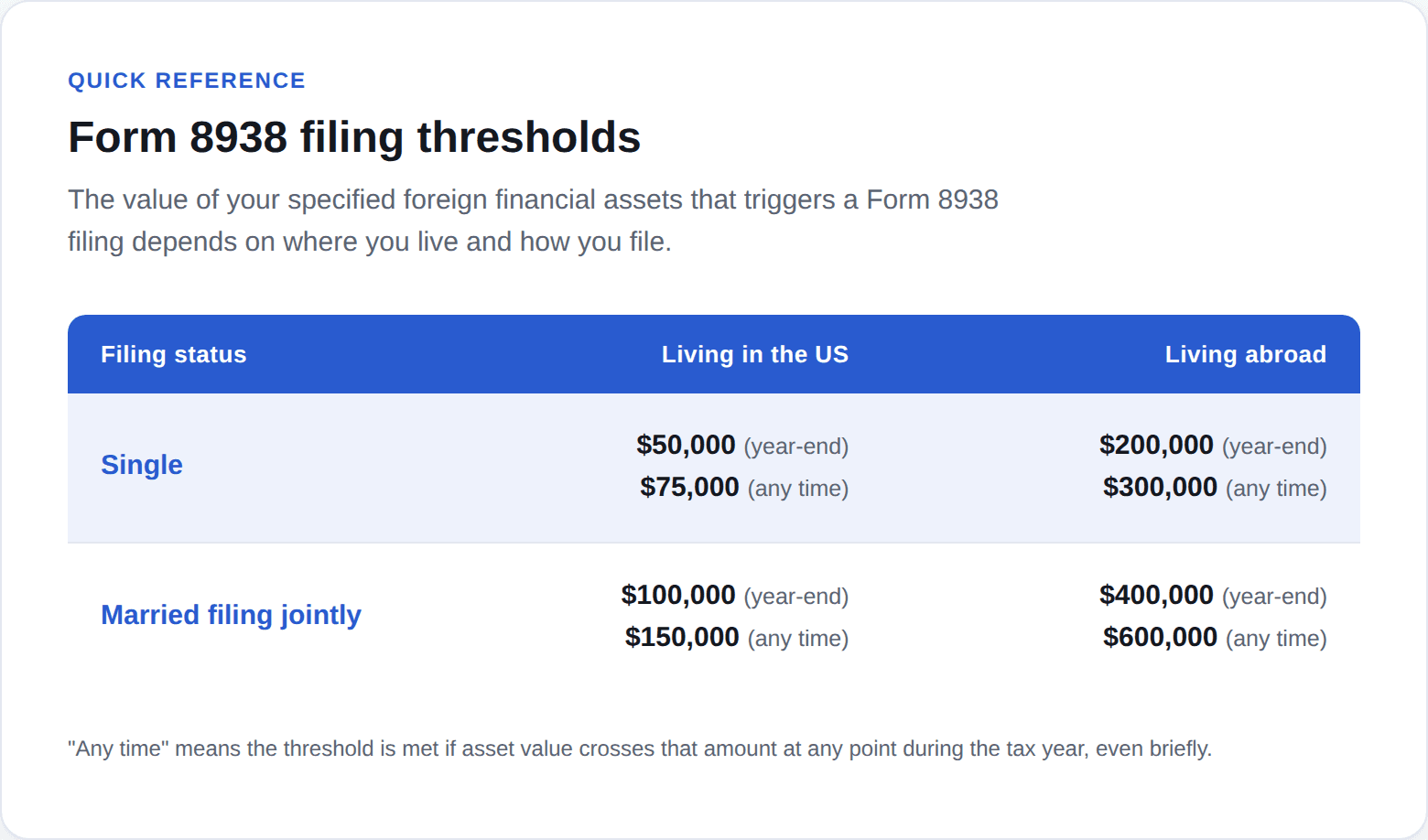
The important part: these thresholds aren't just about your FCNR deposit. For FBAR, you add up the balances of all your foreign financial accounts. For Form 8938, you look at the total value of your specified foreign financial assets. So don't check your FCNR deposit in isolation—your NRE/NRO accounts, other foreign accounts, and other reportable assets may also count.
FAQs
What happens if I don't report my FCNR interest to the IRS?
The IRS can assess back taxes, interest, and penalties once unreported income surfaces, and penalties get significantly worse if it's treated as willful rather than an honest mistake. Correcting it yourself through an amended return puts you in a better position than waiting to be caught.
What if I forgot to report my FCNR account in previous years?
The IRS has procedures for this: amended returns (Form 1040-X) for past tax years, and separate streamlined filing compliance procedures for people who didn't know FBAR or Form 8938 applied to them, which can reduce or remove penalties for honest mistakes. Getting the details right depends on your specific history, so this is worth handling with a tax professional.
Is FCNR interest taxable if I am a US citizen living in India?
Yes. The US taxes citizens on worldwide income regardless of where they live. One thing worth knowing: the Foreign Earned Income Exclusion, which many Americans abroad use to reduce US tax, only covers wages and self-employment income, not interest, so it doesn't apply here. Living abroad does raise your Form 8938 thresholds, since those are higher for people living outside the US.
Does converting my FCNR deposit to an NRE or NRO account change how the interest is taxed?
Converting to NRE changes nothing, it's taxed in the US exactly like FCNR: fully taxable, no credit, since India taxes neither. Converting to NRO is different: NRO interest has 30% tax withheld in India, which does generate a foreign tax credit against your US tax bill, something FCNR and NRE don't offer. That's a real trade-off worth weighing, not just a formality.
Do I need to report an FCNR deposit jointly held with someone else?
Yes, if you're a US person with a financial interest in or signature authority over the account. For FBAR, each US-person joint owner reports the full account balance, not a proportional share, though married couples can sometimes file one joint FBAR instead of two. For income tax, you generally report your share of the interest based on actual ownership. Joint accounts with a non-US-person, like a parent in India, get genuinely complicated depending on whose money it actually is, that's worth a specific conversation with a tax preparer.