

Investment
5 Mins

Apoorva K
Team Rupeeflo
If you’re an NRI planning to lock in the current 6–7%+ FCNR rates, you now have until August 31 (not September 30) to get the deposit mobilised.
The Reserve Bank of India (RBI) has brought forward the deadline for fresh FCNR(B) deposits under its special forex swap facility by one month. The facility, which opened on June 8, was originally meant to run until September 30, 2026. RBI now says eligible FCNR(B) deposits must be mobilised by August 31.
The change came after a much stronger response than expected. By August 13, banks had mobilised $52.3 billion through FCNR(B) deposits, while total inflows across FCNR(B), ECB and OFCB channels had reached $56.85 billion. RBI cited "the encouraging response to the Swap Facility"as the reason for ending it early.
The timing is significant for NRIs because this special swap facility is what has allowed banks to offer unusually high FCNR rates, with some USD deposits currently paying 6–7%+ depending on the bank and tenure.
We’ve explained how the facility works and why FCNR rates jumped in 2026 here: Why FCNR Rates Suddenly Jumped to 7% in 2026.
The ECB and OFCB portions of the broader forex swap facility continue until December 31, 2026. Those are separate facilities used by companies and banks, so that later deadline does not apply to an individual NRI looking to open an FCNR(B) deposit.
Do You Still Have Time to Open an FCNR Deposit at 7%?
Yes, but the real cutoff is likely earlier than August 31 itself.
RBI's rule is that deposits must be mobilised (opened and funded) by August 31 to qualify.
Banks have until September 11 to settle their swaps with RBI, but your deposit still needs to be mobilised by August 31. The Septmeber 11 deadline is purely for banks, a back-end processing detail; it doesn't buy depositors extra time.
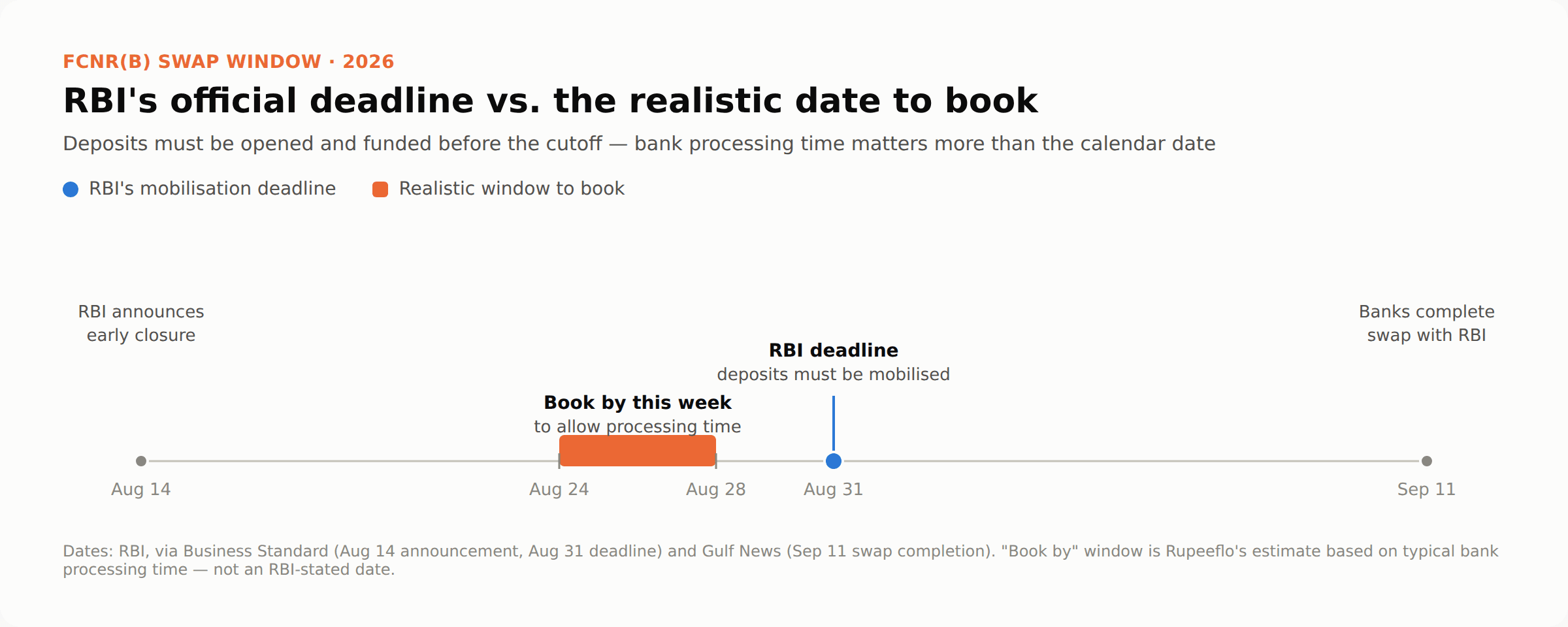
What does eat into your time is your own bank's internal processing. Opening an FCNR deposit as an NRI typically involves KYC verification, linking or opening the account, and wiring the USD funds from your overseas bank, and banks generally need a few business days to complete all of that before the money counts as "mobilised." If you're starting from scratch, August 24–28 is a more practical target than waiting until August 31, because your bank may need time for KYC, account opening and funding.
What You Need to Do Right Now to Book Before the Cutoff
Three things are on you; the rest is your bank's job to process.
Your part: decide which bank and tenure you want, since rates and terms vary (see Best FCNR Rates in India 2026), complete your KYC documentation (passport, visa/residency proof, overseas address proof), and initiate the wire transfer of USD from your foreign bank account.
Your bank's part: verifying your KYC, opening the account, converting or holding the currency per the deposit terms, and confirming the deposit before the RBI cutoff.
If you're moving a meaningful amount of USD to fund this, the transfer itself is worth paying attention to separately from the deposit rate. A poor exchange rate on the way in can quietly eat into the extra return you're chasing.
Already Have an FCNR Deposit? Here's What Happens to Your Rate
Nothing changes for you. Deposits opened before the cutoff keep their agreed rate and full three-to-five-year term regardless of when the swap window closes. The early closure only affects deposits opened after August 31; it doesn't touch anything you've already booked.
If you're weighing whether to break an existing lower-rate FCNR deposit to reopen one at today's rates before the window shuts, that's a separate math problem involving penalties and remaining tenure, covered in Should You Break Your FCNR Deposit to Reinvest at 7%?
What Happens to FCNR Rates After August 31
Without the RBI swap facility, the unusually high 6–7%+ rates currently available are unlikely to persist. Rates could move back toward the levels seen before the facility, although the exact post-August 31 rates will depend on individual banks and market conditions.
If you miss the window, FCNR is still an option, just not at the rates driving the current interest. Best FCNR Rates in India 2026 tracks what's actually on offer bank by bank.